0151 639 8273
Mon - Fri 9am - 5pm

 The Volkswagen Group and the claimants have today reached an out of court settlement in the Volkswagen NOx Emissions Group Litigation. That group action concerns claims, which first became public in September 2015, made in respect of the two mode software installed in certain Volkswagen Group vehicles with EA189 diesel engines.
The terms and conditions of the settlement are confidential.
No admissions in respect of liability, causation or loss have been made by any of the defendants in the group action as part of the settlement. In Volkswagen’s view, the legal costs of litigating this case to a six-month trial in England, and then in relation to any further appeals by either party, were such that settlement was the most prudent course of action commercially.
The agreed settlement resolves the circa 91,000 claims that were being brought against various Volkswagen Group and dealer entities in that group action in England & Wales. These claims were brought on behalf of consumers by the law firms Slater and Gordon, Leigh Day and PGMBM, who were the Court appointed Steering Committee representing all of the Claimants in the conduct of the litigation. Slater and Gordon and Leigh Day were appointed the co-Lead Solicitors.
As a consequence of the settlement, a payment of £193m is being made to the claimants by the Volkswagen Group. A separate contribution is being made by the Volkswagen Group towards the claimants’ legal costs and other fees.
The Volkswagen Group is not participating in the distribution or allocation of the above sums, which will be allocated between the claimants in proportions agreed amongst the various claimant solicitors’ firms and those from whom they take instructions.
The Volkswagen Group would, once again, like to take this opportunity to sincerely apologise to their customers for the two mode software installed in the EA189 vehicles. The Volkswagen Group will continue to work to rebuild the trust of their customers here in England & Wales. This settlement represents an important further stage in that process.
Commenting on the settlement, Philip Haarmann, Chief Legal Officer of Volkswagen AG, said:
“The Volkswagen Group is pleased that we have been able to conclude this long running litigation in England & Wales. The settlement is another important milestone as the Volkswagen Group continues to move beyond the deeply regrettable events leading up to September 2015.”
Commenting on the settlement, Lead Solicitors at Leigh Day Bozena Michalowska and Shazia Yamin said:
“We are pleased that Volkswagen has repeated its sincere apology for the use of the prohibited two mode software. We are delighted that this case has finally been settled for our clients and the claimants in the NOx emissions litigation. We have been unwavering in our belief in our clients’ case, that is why we have fought long and hard for this outcome. We are clear that it was in the interest of our clients to settle this early.”
Commenting on the settlement, Slater and Gordon CEO David Whitmore said:
“At Slater and Gordon, we are passionate about securing the best possible outcome for our customers, and I am immensely proud of this result. Over the last 5 years, Slater and Gordon have rightly dedicated a significant and unwavering commitment to this case, providing an expert voice to around 70,000 claimants. The settlement avoids the need for a lengthy, complex and expensive trial process and we are delighted to have achieved this settlement for our customers as a result of the group action.”
Tony Winterburn, a Partner and Head of Consumer Protection Litigation at PGMBM, who acted on behalf of more than 15,000 Claimants in the Litigation, commented:
“This is a good day for the Claimants and is the culmination of 5 years of hard-fought litigation.”
The settlement applies only to claims in the Volkswagen NOx Emissions Group Litigation. It has no bearing on any other claims relating to other engines in England & Wales or any other jurisdiction.
 Our office will be closing at 5pm on Thursday, 23rd December 2021 and will re-open at 9am on Tuesday, 4th January 2022.
 The murders of Sarah Everard, and Sabina Nessa in 2021, and the storm of media coverage and online conversation surrounding them. have once again brought the issue of male violence against women to light in heart-breaking fashion. Although these cases have quite rightly gained media and sparked a wave of protest, discussion and debate about the issue, it is certainly not a new phenomenon. This is particularly true for those engaged in representing parties in the family courts on a daily basis.
The World Health Organization reports that globally, a staggering 1 in 3 women are subjected to violence from, most commonly from an intimate partner. Recent reports into police handling of violence against women and girls concluded that there is currently an ‘epidemic’ of such crimes.
Further statistics make for grim reading. The Crime Survey for England and Wales for the year ending March 2020 identified the following:
Alongside the enduring fact that women continue to face unacceptable risk of physical and sexual violence, there is also a growing understanding of what constitutes controlling or coercive behaviour. This is reflected in the development that such behaviour has been a criminal offence since 2015. Data shows that the victims of this behaviour are far more likely to be women, and the perpetrators likely to be men.
Many people struggle to define what coercive control in a relationship looks like, as it is far less easy to identify than signs of physical violence. It can include (amongst other signs) threats, deliberate humiliation, and attempts to isolate the victim from friends and family.
Work in family law has seen an increased focus on the effects of coercive control, which was recently highlighted in a significant judgement from the Court of Appeal in March of this year. Those working to represent clients in family law proceedings will need a full and clear understanding of what coercive control looks like, in order to best advise their clients on the best way forward.
The reality is that society has a long way to go before meaningful change for women and girls is seen. An author of a recent review of police responses to violence against women has recommended a ‘radical change of approach across the whole system, which is unlikely to happen overnight’ However, there are practical steps that can be taken.
If you believe that you or someone you know is a potential victim of any of the behaviour set out above, you should first consider whether to involve the police, particularly if there is a risk of immediate harm.
A member of the team at Burd Ward can assist you in obtaining a non-molestation order, preventing the perpetrator from contacting you or coming near your address. Legal Aid is available for these applications, and a member of our team will be happy to advise you on your eligibility.
 Laura Prysor-Jones, a member The Family Law Team at Burd Ward has established links with support services for victims of domestic abuse across Wirral. She is trusted by these groups to provide a sensitive and considerate service to our clients. You can reach out to us on 0151 639 8273 or contact her at lpj@burdward.co.uk for more information.
 A long-awaited change to the law governing divorce and dissolution of civil partnerships in England and Wales will at last come into force on 6th April 2022, ministers have announced today. The Divorce, Dissolution and Separation Act received royal assent on 25 June 2020 and became law but has yet to be fully implemented by the Government. The Act will introduce a number of reforms to current divorce law, most notably allowing for a ‘no-fault’ divorce. In practice, this will remove the need for a party applying for a divorce to rely on the conduct of the other person under one of a number of grounds in order to show that the marriage has broken down. Once implemented, the reforms will allow for any party seeking a divorce to simply file a statement confirming that the marriage has irretrievably broken down. The other party in the marriage will not be able to contest the divorce once this statement is filed.
It is hoped that once these reforms are implemented, the divorce process will become quicker, simpler, and less immediately stressful for separating couples. The changes have long been campaigned for by family practitioners, as it is hoped that by removing the need to show fault on the part of the other party, both individuals can instead choose to focus on the important issues that come with the end of a marriage. In most circumstances, the issues of finances and arrangements for the children of the marriage will be at the forefront of people’s minds. By removing one layer of conflict from the situation, these reforms will hopefully allow for divorcing couples to be better placed to negotiate where appropriate and come to a swifter resolution for the benefit of both themselves and their children.
These reforms are the biggest shake-up of the divorce procedure in decades, and the delay in implementation has been caused part by the need to make sweeping changes to court forms, application processes and guidelines for family lawyers. However, the Government have now committed to an implementation date of April 6th 2021. Before then, couples wishing to divorce will need to continue to apply under the current law and procedure.
If you are looking for any further information or specific advice in respect of a divorce, the specialist family law team at Burd Ward are here to help. We offer advice in respect of all elements of family law ranging from divorce and finances to arrangements for children. For all new enquiries, please contact 0151 639 8273 or email info@burdward.co.uk
The announcement this week that Bill and Melinda Gates are to divorce after 27 years of marriage has made headlines globally. With an estimated combined worth of $130.5b, the couple’s separation looks set to be the most expensive in history, and may have lasting implications for the future of Microsoft and the extensive charity work undertaken by the Gates’ foundation. Whilst most of us will never experience anything close to the wealth this couple possesses, there are some general points we can all take away from the announcement.
One trend that the Gates’ announcement has highlighted is the increase in couples aged 60 and over choosing to separate, which has been noted in both the UK and the USA. The Office for National Statistics reports that between 2005 and 2015, the number of male divorcees rose by 23 percent, and by 38 percent for women. Perhaps unsurprisingly, the ONS also reports that remarriages for over 65s also rose dramatically between 2007 and 2017. This trend raises the importance of careful pension planning, and is likely to mean that solicitors are faced with more complex cases as a result of lengthier marriages ,where the prospect of a pension sharing order or other direction from the court looms large.
The Gates’ divorce is likely to be extremely complex, owing to the vast sums involved and the length of the couple’s marriage. If nothing else, the case will highlight the need for any party to a divorce to have a solid understanding of their own finances, their earning capacity now and in the future, and any other non-financial contributions they may have made to the marriage. Having this knowledge is important before entering into any financial negotiation with the ex-spouse, or in court proceedings should negotiations be unsuccessful. Seeking advice as early as possible from an experienced solicitor is crucial to beginning the process on the right footing.
Burd Ward’s Family Law team offer a sensitive, thoughtful and comprehensive approach to matrimonial issues. They are happy to advise and represent clients in respect of divorce, finances, and any issues relating to children. Contact our team for more details.
 The law and procedure of personal injury and in particular claims for ‘whiplash’ injuries caused in road traffic accidents will undergo a seismic change from the 31st May 2021. For accidents which occur after this date the vast majority of these claims will be dealt with by the injured person via the new small claims portal.
The Government have introduced a number of changes which will come into force from the 31st May 2021 which will alter the way personal injury claims are dealt with in a large number of cases. The major changes are as follows:
The detail for the procedure to follow for claimants can be found in “the RTA Small Claims Protocolâ€.
The new system for ‘whiplash’ claims will apply to non-protected adults who suffer whiplash injuries whilst in a vehicle from the 31st May 2021.
The new system will not apply in the following situations:
Set out below is the tariff system which will come into force from the 31st May 2021.
The first column represents the award for a physical injury alone and the second column represents the award for a physical injury accompanied by a minor psychological injury.
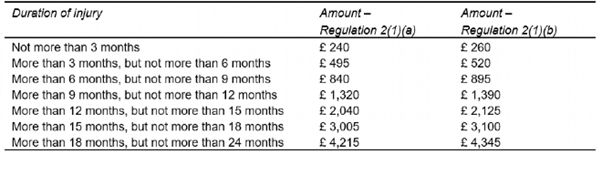
Only if a claimants injury falls within the definition of ‘whiplash’ will the new system be of relevance. If you suffer injuries outside of this definition then the old regime will apply and I would invite you to contact us for advice and assistance.
The Civil Liability Act 2018 defines whiplash as follows:
If you have been involved in a road traffic accident and feel that you fall outside the scope of the new regime then please contact one of our personal injury experts, Michael Ward or Matthew Barlow by email or call us on 0151 639 8273.
 The beginning of a New Year is the best time to de-stress, de-clutter and get your personal affairs in order for the year ahead.
Now that we are all spending more time at home, it is a good opportunity to get round to ticking some things off your life admin list. One thing most people plan to do is put their affairs in order but often this is pushed to the bottom of the list. Why not use this time to organise your legal arrangements for the future?
This could include:
We have facilities in place to ensure we are able to assist you with all of the above despite the current crisis. We also continue to offer advice in relation to family law; employment law; personal injury; conveyancing and advice for businesses.
Call us on 0151 639 8273 for more information. We are here to help.
The process of dealing with someone’s estate can be daunting and involve a lot of complicated legal, tax and financial work.
The first step to be undertaken is to identify the deceased’s assets and liabilities and value the same as at the date of death.
Once this has been done, the correct inheritance tax form needs to be completed and any inheritance tax paid, if applicable, to HM Revenue & Customs.
An application is then made to the Probate Registry for the Grant of Representation. This is called a Grant of Probate if there is a valid Will appointing executors or a Grant of Letters of Administration if the deceased died without making a Will.
The Grant gives authority to deal with the collection of the deceased’s assets from which the liabilities must then be paid.
The deceased’s income tax affairs also need to be finalised with HM Revenue & Customs.
Once all of this has been done, estate accounts are then prepared, showing all of the assets and liabilities, together with the amounts due to the beneficiaries. One these have been approved, the monies due can be distributed to the beneficiaries.
Many people find it helpful to instruct a solicitor to deal with the administration of an estate on their behalf. They have peace of mind knowing that the estate is being administered correctly and saves stress at what is often an upsetting time.
If we at Burd Ward Solicitors can assist in dealing with the administration of an estate, please do not hesitate to contact us.
In a highly publicised case, the Courts recently ruled that a 68 year old woman must remain married to her husband. Mr and Mrs Owens separated in 2015 and the wife issued proceedings based upon her husband’s unreasonable behaviour. The Court however felt that her reasons were “flimsy†and refused her application. The wife appealed, firstly to the Court of Appeal and then to the Supreme Court. They both held that the Judge was right to refuse the application but stated their unease at the situation. The Court of Appeal called for the introduction of no-fault divorces. As it stands, the wife now must wait until she has been separated from her husband for 5 years in order to petition without his consent.
We often see clients who have been separated less than a year who want to get divorced but they cannot find a suitable fact to rely upon. There may have been no adultery or unreasonable behaviour and the couple have simply drifted apart. In those circumstances they have to wait until they have been separated for two years (if both parties agree to the divorce) or five years if their spouse won’t agree. A recent survey found that 3 out of every 10 couples “bent the truth†about adultery or unreasonable behaviour in order to ensure their petition was accepted by the Court. More than a third said having to apportion blame in the petition increased their anguish at what is already a very difficult time.
At Burd Ward we are committed to helping you navigate a relationship breakdown in a sensitive manner. Whilst there is not yet a “no fault†divorce, our specialists can advise you on the law as it stands and guide you through all aspects of a separation.
If you are considering separating or starting divorce proceedings, it is well worth taking legal advice before you take any steps. We offer a fixed fee of £350 + VAT and disbursements for handling your divorce. There is a Court fee of £550 to pay however depending on your income you may be eligible for some relief from this. We can assist you to fill in a fee remission form which can be sent to the Court who will then assess whether you have to pay all, some or none of the Court fee.
Using a solicitor to handle your divorce gives you peace of mind to ensure that your divorce progresses as smoothly as possible. There are often issues around finances and children upon separation and our experienced family team and are able to advise and represent you through those aspects of a separation.
If you would like more information regarding divorce proceedings please contact Laura Prysor-Jones on 0151 639 8273.
Shoe Be Doo is back for 2018. This year we hope to make the campaign bigger and better than ever. In previous years, Shoe be Doo has been a huge success and thanks to the children and parents of The Prep hundreds of families on the Wirral have benefited from receiving the school shoes and other items of uniform.
Many families across Wirral are struggling to provide some of life’s every day essentials for their families. Expensive items such as school uniform and shoes can be particularly hard to budget for in families surviving on a low income.
The Shoe Be Doo Campaign is aimed to help those families, living locally to you, who are struggling.
For more information check out the Shoe-be-doo campaign page.